There will be scars
- Oct 4, 2017
- 3 min read

Gillian from London is one of 14 women who appear in ‘Mastectomy,’ a breast cancer awareness campaign hosted by Stand Up To Cancer, showcasing 14 women proudly displaying their scars after breast cancer-related surgeries.
In yesterday’s rambling blog about bras (You’re welcome male reader(s)!), I mentioned people living with breast cancer must become comfortable with a few things, including:
1. There is a lot (A LOT) of naked time.
2. You must learn to accept cold hands on your warm bits.
3. Scars. There will be scars.
** List is subject to change as I unrepress memories of more stuff. **
Yes. A person living with breast cancer likely has a few scars on their body. Whether from a lumpectomy, mastectomy or reconstruction, the scars can be minimal to large enough to make you want to never be naked again.
I have mixed feelings about the scars on my body. Some are small, robot-assisted surgery kind of small. Others are large, drive a dump truck through a tunnel opening large.
When I was first diagnosed in 2013, the likelihood of more scars on my body bothered me.
Before breast cancer, I broke my left leg as a teen and had to have it surgically repaired. The scar from that surgery runs from just above my ankle to below the knee. I also compound fractured my right ankle and leg. The scars from that surgery are, surprisingly, much more discreet and also covered over by two tattoos. (Note: Getting a tattoo over a scar hurts. It hurts even more when the ink needle hits surgical steel in the bones below.)
Then, the cancer-related scars came about. At my waist is the DIEP flap reconstruction scar. I underwent reconstruction immediately after a double mastectomy on Oct. 10, 2013. This reconstructive surgery is a modern marvel, if you ask me.
In a DIEP flap procedure, blood vessels, skin and fat are removed from a person’s abdomen and transferred to the chest to rebuild breasts after mastectomy.
For me, the mastectomy and reconstruction surgery took about 14 hours. When I woke from anesthesia, I wasn’t immediately aware of the incisions across my abdomen and around my new breast mounds. (God, I hate that term!) The next day, however, I screwed up my courage and looked beneath the hospital gown.
What I saw shocked me. The incisions were red, angry and forever on my body. I remember looking at the flowers on the window ledge beside my hospital bed and thinking: ‘The flowers are so beautiful. You, my friend, are not.’
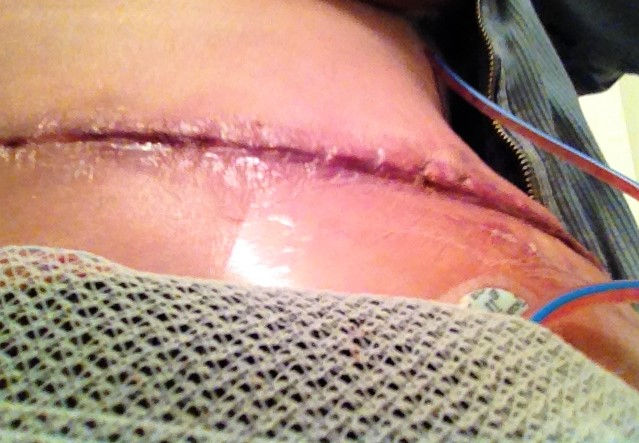
This is the scar I saw on my body on Oct. 11, 2013, the day after a double mastectomy and DIEP flap reconstruction. It’s not as red and angry today but it’s still there. A reminder of my story with breast cancer.
In time, the incisions healed. They are trailed across my torso like a pretty strange road map. When I think about them, I’m not as bothered as I used to be. I don’t like them but the scars tell a story about my life.
That brings me to 14 very brave women in the United Kingdom and a breast cancer awareness campaign dubbed ‘Mastectomy.’
The campaign hosted by Stand Up To Cancer includes photos of the 14 women proudly displaying their scars after breast cancer-related surgeries.
The photos were shot by Ami Barwell and inspired by her mother, Sue, who has faced breast cancer twice. After watching her mother go through treatments, Barwell said she wanted the campaign to illustrate that her subjects are ‘strong, happy and sexy.’
‘It was absolutely devastating when my mum was diagnosed with breast cancer,’ Barwell said. ‘I wanted to shoot this project to raise awareness and show the defiance of women who remain equally as beautiful without breasts. Stand Up To Cancer is about bringing people together to rebel and rise up against cancer. The photographs show that, despite what they’ve been through, these women are empowered.’
Stand Up To Cancer is a joint fundraising campaign from Cancer Research UK and Channel 4 that raises money to support cancer research.
You can learn more about the ‘Mastectomy’ campaign and Stand Up To Cancer at these websites:
These women are brave beyond words, I think. Not only did they face cancer and its treatments but they stripped themselves bare to raise awareness.
For me, I can only share the photo of my abdominal incision. I’m not ready for many people to see my reconstructed breasts.
The scars I have do tell a story. It’s a difficult story to tell and to witness.


Comments